
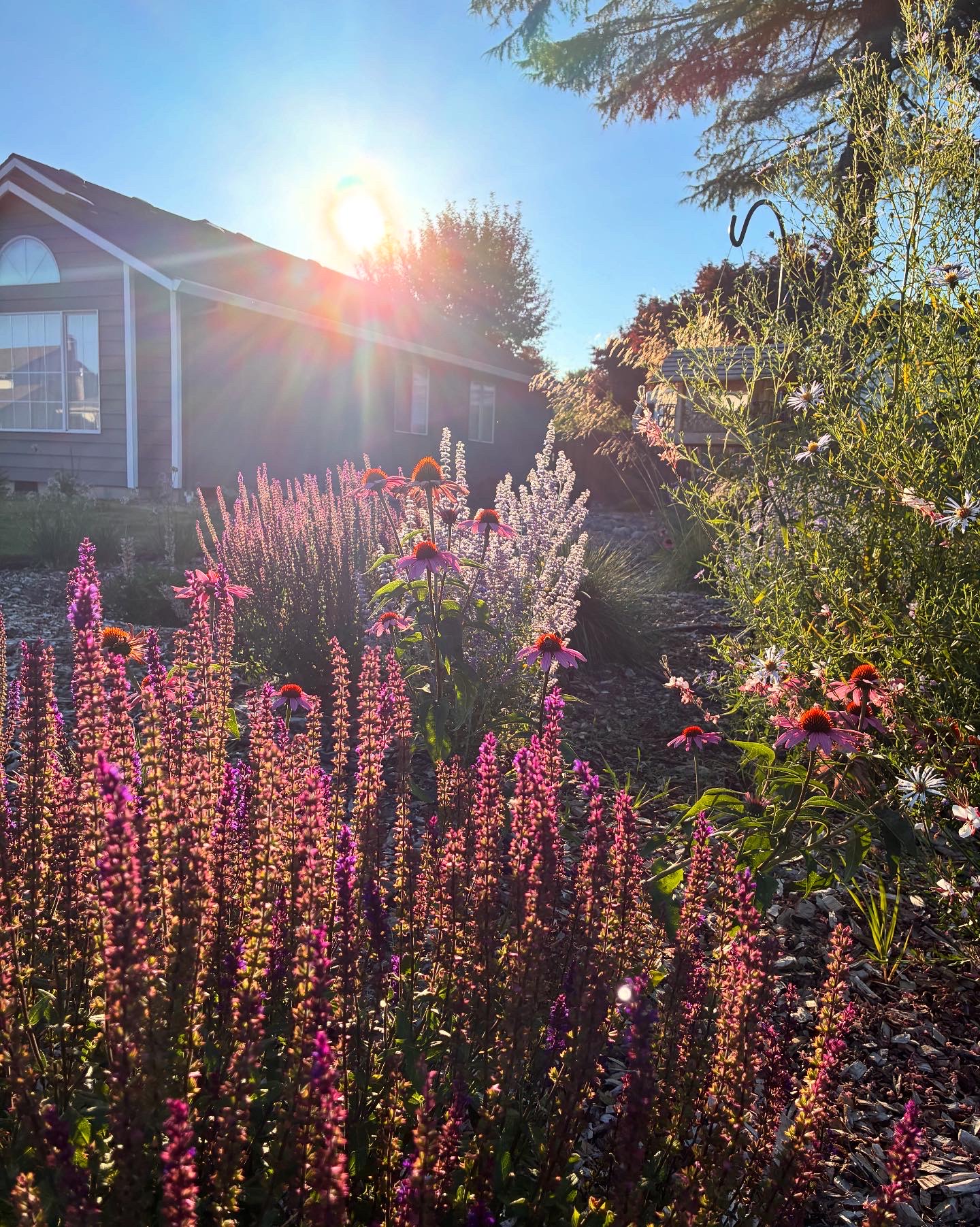
There's a particular kind of garden that makes me uneasy. You've seen it. Every shrub trimmed into a perfect hemisphere. Grasses cut to uniform height. Borders so crisp they look drawn with a ruler. Mulch raked smooth as a putting green.
It's a garden that's trying very hard to look controlled. And that effort shows.
I understand the impulse. We spend real money on our outdoor spaces, and it feels responsible — respectful, even — to keep them tidy. But there's a difference between a garden that's cared for and a garden that's been subdued. One feels alive. The other feels defended.
The Thing That's Hard to Name
The gardens I find most beautiful have a quality that's hard to name but immediately felt. A looseness. A sense that the plants are doing something — leaning into the light, seeding into the gravel, blurring the edge between bed and path. There's movement. There's layering. There's the suggestion that if you came back in a week, something would be slightly different.
Wispy is the word I keep coming back to. Wispy grasses catching afternoon light. Wispy seedheads holding their form into December. The wispy edge of a perennial planting where it meets the lawn and refuses to make a clean line.
Wispy is not neglect. A wispy garden requires enormous skill and intention — possibly more than a tightly controlled one.
You have to know which plants will move beautifully and which will just flop. You have to understand bloom succession so there's always something carrying the moment. You have to be confident enough to leave the seedheads standing when every conventional instinct says to cut them back.
A Garden Is Never Finished
What wispy resists is the idea that a garden's job is to be finished.
A finished garden is a static garden. It's a photograph. And photographs don't have the thing that makes gardens worth having — that particular quality of being alive, of doing something you didn't entirely plan for.
The landscapes that stay with me are the ones that felt discovered. A coastal meadow where grasses and wildflowers have sorted themselves into something more beautiful than any designer could have arranged. A Japanese garden where moss has taken over a stone's surface over decades and made it more itself than it was before. A neglected farmhouse garden where an old rose has climbed through a dead tree and made the whole composition feel inevitable.
None of those things were designed to be finished. They were designed — if designed at all — to keep becoming.
What Rewilding Actually Means
This is what I mean when I talk about rewilding. Not releasing a garden to pure chaos, but designing with the understanding that the landscape has a direction it wants to go, and your job is to understand that direction and work with it. Choose plants that self-sow thoughtfully. Allow edges to blur. Let the ornamental grasses lean a little. Keep the seedheads through winter — they're feeding something, and they're beautiful, and the garden is better for them.
The Pacific Northwest is particularly suited to this approach. The density of the plant palette here, the way things layer naturally, the moss that will colonize every surface you invite it onto — all of it creates conditions for that discovered quality faster and more completely than almost any other climate I know. The challenge isn't getting things to grow. It's being selective enough, and patient enough, to let the garden find its own character.
The Clients Who Get It
The clients who resonate most with this approach are usually the ones who feel vaguely dissatisfied with what they see in most landscape portfolios but can't articulate why. What they're sensing, I think, is exactly this: a garden that's been too finished. Too controlled. Too loud about the fact that a designer was here.
The quietest gardens are the best ones. The ones that make you forget, immediately and completely, that anyone made them at all.
That's the standard I design toward. Not the photograph. Not the finished thing.
The feeling of somewhere you've always wanted to find.